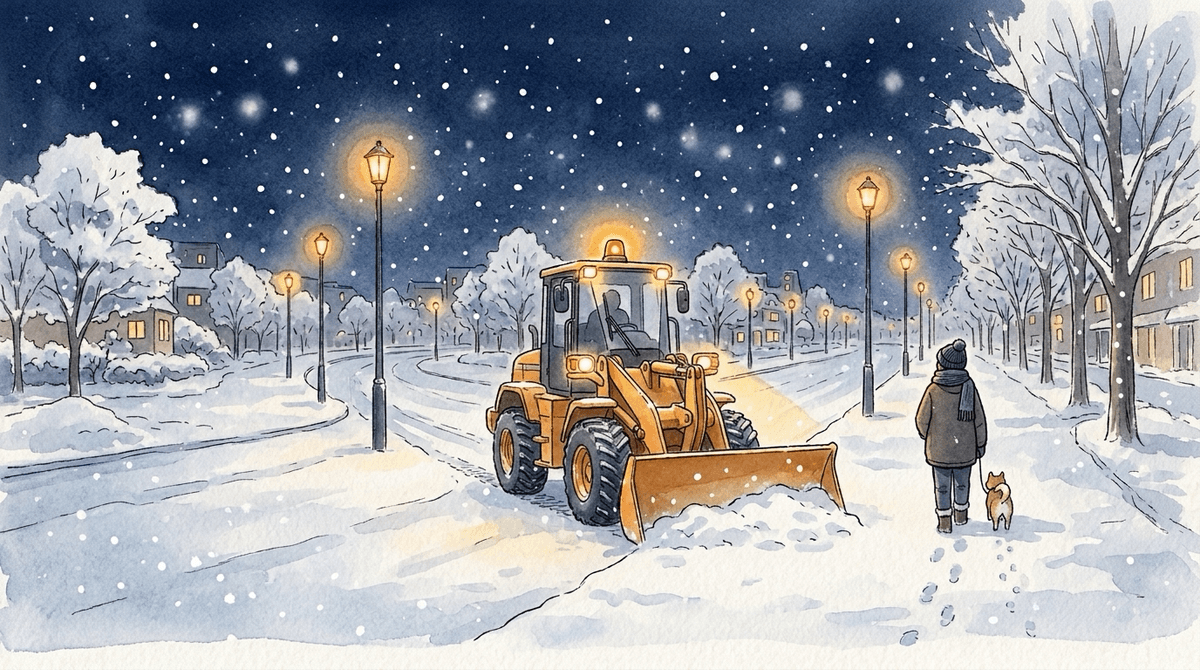
Deeper snow than January. What to wear?
What to Wear in Hokkaido in March: The Month the Snow Is Deeper Than January (JMA Data)
March is still winter, with better light
If you are planning a March trip to Hokkaido, here is the number that should shape your packing list.
In Sapporo, the normal deepest snow on the ground in March is 82 cm. In January it is 76 cm.
That is not a freak year. Those are the Japan Meteorological Agency's official 1991–2020 normals for the Sapporo observatory. Far less new snow falls in March than in January — 74 cm against 137 cm — but everything that fell all winter is still lying on the ground, and in Sapporo the snowpack normally lasts until 2 April.
So the short answer: pack for winter, with waterproof boots that grip on ice, sunglasses, and layers you can open at midday. March is not spring here. It is the last month of winter, with much better light.
Coming earlier in the season? See What to Wear in Hokkaido in Winter for December to February.
What the numbers say
These are JMA 1991–2020 climate normals for March.
| City | High / low | New snow | Deepest snow |
|---|---|---|---|
| Sapporo | 4.5 / −2.4 °C | 74 cm | 82 cm |
| Asahikawa | 3.0 / −6.1 °C | 80 cm | 82 cm |
| Hakodate | 5.8 / −2.2 °C | 41 cm | 28 cm |
| Kushiro | 3.3 / −4.2 °C | 31 cm | 23 cm |
In Fahrenheit, Sapporo's March is a high of about 40 °F and a low of about 28 °F. Asahikawa's low is about 21 °F.
Three things in that table matter more than the averages.
Above zero by day, below zero by night. Every one of the four cities has a March high above freezing and a March low below it. That single fact decides your footwear, and we come back to it below.
Inland stays deep. Asahikawa and Sapporo both have a normal March maximum of 82 cm of snow on the ground. Hakodate and Kushiro have a third of that.
It still snows a lot. Sapporo records snow on a normal 24.5 days in March, against 29.1 in January. What changes is how much falls each time, not whether it falls.
Melt by day, ice by night
Read Sapporo's high and low together — 4.5 °C and −2.4 °C — and you have the whole month. Snow softens and melts in the afternoon sun. Water runs across pavements and pools at crossings. After sunset it freezes again.
Sapporo's Winter Life Promotion Council, which studies falls on icy pavements using fire-department ambulance data, describes exactly this pattern as one of the main ways slippery surfaces form: packed snow melts in sunshine or warmth, then refreezes when the temperature drops or the sun goes. It singles out one situation in particular — plenty of snow on the ground, the temperature rising above zero, then falling below again. In March that is an ordinary day.
To be clear, December is the month with the most falls in Sapporo, partly because people have not yet got used to the ice. March is not the worst month. But the calendar says spring, so visitors do not expect it.
The council's English site, Walk Smart, has short guides to walking on snowy streets and the spots that are most slippery. Five minutes there before your trip is worth it.
You will also see small boxes of grit at busy crossings in central Sapporo, near subway and JR stations. The sand inside is for anyone to scatter on an icy pavement, according to the City of Sapporo. If a crossing is glassy, use it.
Boots first, then everything else
In March, what is on your feet matters more than what is on your back.
- Waterproof boots with an ice-gripping sole. Above the ankle, because you will step in slush. The Winter Life Promotion Council lists the soles that work on ice: metal pins or studs, deep tread, soft rubber, and rubber with anti-slip grit mixed in. Two warnings from the same guide: a hard sole with deep tread, like many trekking boots, can still slip on polished ice, because softness matters as much as depth; and metal pins can slip on indoor tiles, which you will walk on a lot in Sapporo's underground walkways. Trainers and leather-soled shoes are not suitable.
- Slip-on ice grips (suberidome) as a backup. They fit over normal shoes, are sold at drugstores and home centres in Hokkaido, and fold into a pocket.
- Trousers you do not mind splashing. Passing cars throw slush. Dark, water-resistant trousers survive March.
- The midwinter three layers, one step lighter. A base layer, a fleece or wool mid layer, and a windproof outer shell. You will want to open the shell at noon and close it again by four. Trains, buses, shops and restaurants are heated, so clothes you can take off quickly beat one very heavy coat.
- Gloves and a hat. The normal low is below freezing in all four cities.
Winter boots sold in Hokkaido are called fuyu-gutsu. If you are buying after you arrive, tell the shop staff where you will be walking; the council's own advice is that no single sole works on every surface.
Bring sunglasses
This is the March item people forget.
Sapporo gets 144.7 hours of sunshine in an average March, against 90.4 hours in January. The midday sun also climbs from 39° above the horizon on 1 March to 51° on 31 March. All of that light lands on a white city still covered in snow.
On a clear March morning the glare off the snow is hard on the eyes, and harder still if you are driving towards a low afternoon sun. Sunglasses earn their place in the bag in March.
March is two different months in Hokkaido
In March, Hokkaido splits. The clearest way to see it is the date the continuous winter snowpack normally ends, and the date of the last snowfall of the season.
| City | Snowpack ends | Last snowfall |
|---|---|---|
| Hakodate | 10 March | 16 April |
| Kushiro | 11 March | 1 May |
| Sapporo | 2 April | 21 April |
| Asahikawa | 7 April | 1 May |
JMA normals, 1991–2020. "Snowpack ends" is the last day of long-lasting snow cover; patches of snow and fresh falls can come back after it.
What this means for packing:
- Hakodate in late March is the mildest of the four (a normal high of 5.8 °C). Expect wet pavements, some bare ground and cold rain or sleet. Still bring boots: at the Hakodate observatory, the normal last day with at least 1 cm of snow on the ground is 28 March.
- Kushiro on the Pacific side gets the least snow (31 cm for the month) and the most sun (200.8 hours, the highest of the four). It is also the windiest, with an average March wind of 5.8 m/s against Sapporo's 3.8 m/s, and its nights are the second coldest after Asahikawa. Sunny does not mean warm there — a windproof shell matters most.
- Sapporo is still under snow all month.
- Asahikawa and inland are winter in everything but name: the coldest nights (−6.1 °C normal low) and snow on the ground into April. Dress for these from the winter guide.
If your trip covers more than one of these, you are packing for two months in one bag. The answer is still boots.
If you are driving
Three things change compared with midwinter.
- The road surface changes during the day. Morning ice, afternoon slush, evening ice again. Slush pulls at the steering more than packed snow does. Leave extra distance and brake earlier than feels necessary. Our winter driving guide explains the surfaces you will meet.
- Your rental is still on winter tyres. Hokkaido rental cars run on studless winter tyres from roughly November to April, so a March rental will have them. You almost certainly will not need chains. See what your rental comes with.
- Mountain roads are still closed. The earliest of Hokkaido's seasonal mountain roads does not reopen until mid-April, and most stay shut into May or June. A map app can still route you to a locked gate. Check our mountain pass closure calendar before planning a mountain day.
One March habit worth adopting: keep the windscreen washer topped up. Melting snow throws a grey spray of road grit onto the glass, and against a low sun it can blind you. The City of Sapporo collects the winter's anti-slip sand from the streets in early spring, which tells you how much of it is out there in March.
Daylight comes back fast
March is the month Hokkaido gets its evenings back. In Sapporo the sun sets at 17:23 on 1 March and 17:59 on 31 March, while sunrise moves from 6:12 to 5:20. Across the month the day gains almost an hour and a half.
In practice, a March afternoon still works for sightseeing at four o'clock, which a January afternoon does not. The ice still re-forms after dark — just later in the evening.
The packing list
In the order you will need it:
- Waterproof winter boots with an ice-gripping sole, already broken in
- Slip-on ice grips
- Windproof outer shell with a hood
- Fleece or wool mid layer you can remove indoors
- Two thin base layers rather than one thick one
- Gloves and a hat that covers your ears
- Sunglasses
- Dark, water-resistant trousers
- A dry pair of socks in your day bag
Coming later in spring? See what to wear in Hokkaido in May.
FAQ
Q. Is March a good time to visit Hokkaido?
It is a brighter, quieter version of winter. The snow is still there, the light is much better than in January, and the Snow Festival crowds of February have gone. If you want the festival itself, see our Sapporo Snow Festival guide.
Q. Do I need snow boots in March?
Yes. Streets in Sapporo and Asahikawa are under snow all month, wet in the afternoon and icy after dark. Waterproof boots with a grippy, soft sole are the single most important item.
Q. When does the snow disappear?
The continuous snowpack normally ends on 10 March in Hakodate, 11 March in Kushiro, 2 April in Sapporo and 7 April in Asahikawa. Snow can still fall after that — the normal last snowfall is in mid to late April in Hakodate and Sapporo, and 1 May in Kushiro and Asahikawa.
Q. Is a spring jacket enough?
Not for a whole day. Sapporo's average March temperature is 1.1 °C. A light jacket may be fine for an hour at noon, but you will want winter layers by late afternoon.
For the rest of the year, see our month-by-month Hokkaido packing guide.
Before you travel: The climate figures on this page are 30-year averages (Japan Meteorological Agency normals, 1991–2020) — any given March can run warmer or colder, and this page is not a forecast. Sunrise and sunset times are from the National Astronomical Observatory of Japan for March 2027. For current conditions, check the Japan Meteorological Agency, your rental company and official road information before you set out.
Hokudora (ホクドラ) is a Hokkaido driving and travel site based in Sapporo. More English guides · 日本語版はこちら
Get Hokkaido tips in your inbox
Twice a month we send a short letter from Sapporo: what's on in Hokkaido right now, plus practical guides for exploring by car. Free, no spam, unsubscribe anytime.
Delivered via Substack.
More English guides

Hit a Deer in Hokkaido? What to Do Next (Rental Car Guide)
2026-11-24
Can You Sleep in Your Car at a Hokkaido Michi-no-Eki? The Rules, and Why Winter Changes the Answer
2026-11-24
New Year in Hokkaido 2026–2027: What's Open, What's Closed, and How to Plan a Drive
2026-11-24
What to Wear in Hokkaido in May: Spring a Month Late, Cold After Dark (JMA Data)
2026-11-24